 Folk AI
The specialist view
A psychiatrist sees a client for an hour a month. The information that matters most is generated in the other ~700 hours — and today it is simply lost, or filtered through whoever can self-report. Folk closes that gap: objective wellbeing signals between sessions, in professional language, without asking the person to keep a diary.
The RED LINE — printed on the door, enforced behind it. The clinician sees mood trajectories, theme labels, engagement and safety events as severity + type + a privacy-safe paraphrase. Never the messages. It is a database guarantee (Row-Level Security), re-checked on every API route — not a promise in the UI. How privacy is enforced →
A role-gated workspace — for the clinic, not the family.
Clinicians sign in on the same screen as everyone else and choose the specialist tab; what opens behind it is a workspace of their own, separate from the guardian app — one clinician, a whole caseload. Add a client with a single connection code — the same one the person already uses; no new account for the person. The promise is printed on the sign-in itself, and enforced on every request behind it: Folk AI never shows the client's conversations.
- Email one-time-code sign-in; the clinician role is re-checked on every API route, not just at the door.
- A consent gate holds across the whole panel — reports, day breakdowns, narratives, session prep and triage all fail closed until the person accepts. Safety alerts and your own notes are never gated.
- A persistent human-oversight notice stays on screen: everything AI-drafted is decision support, and it requires clinician confirmation.
Folk AI never shows the client's conversations.
AI-generated decision support — requires clinician confirmation.
Who needs attention — ranked.
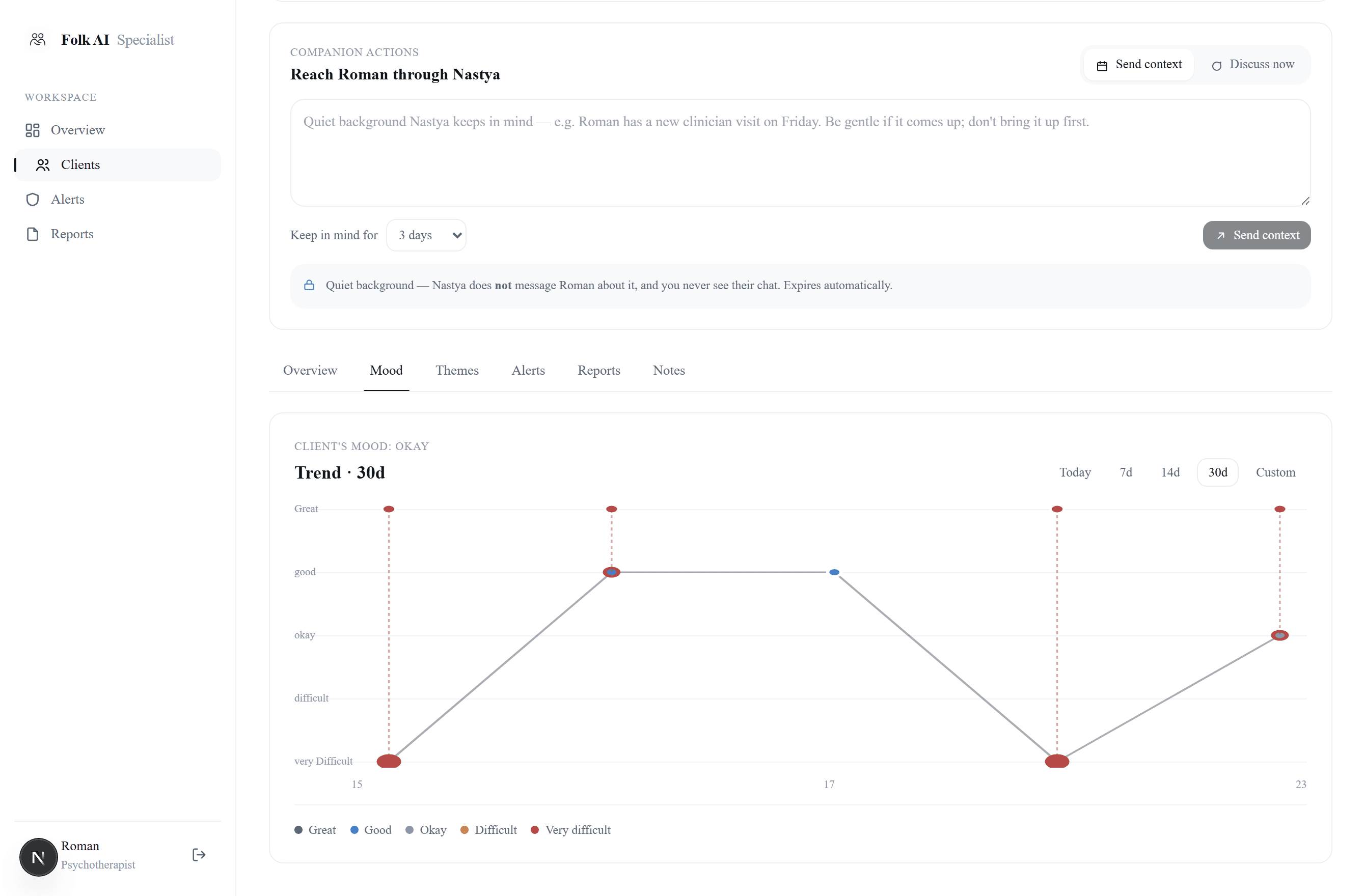
The caseload opens ranked by who needs attention first. Each row is an at-a-glance read: a graded colour status, the direction over the last 7 days, open alerts, presence and the report state. The overview is driven by the same computation, so the list and overview can never disagree — and the mood scale is the same one the family sees. Clinic and home read one truth, not two.
- Live buckets — needs attention · watching · quiet — with running counts, so a 40-client list collapses to the three that matter today.
- Direction over 7 days, separate from the level — a difficult-but-turning week reads differently from a difficult-and-sinking one.
- Last-seen presence and a per-client trend, so silence itself is visible — withdrawal is often the first sign.
It opens with what changed.
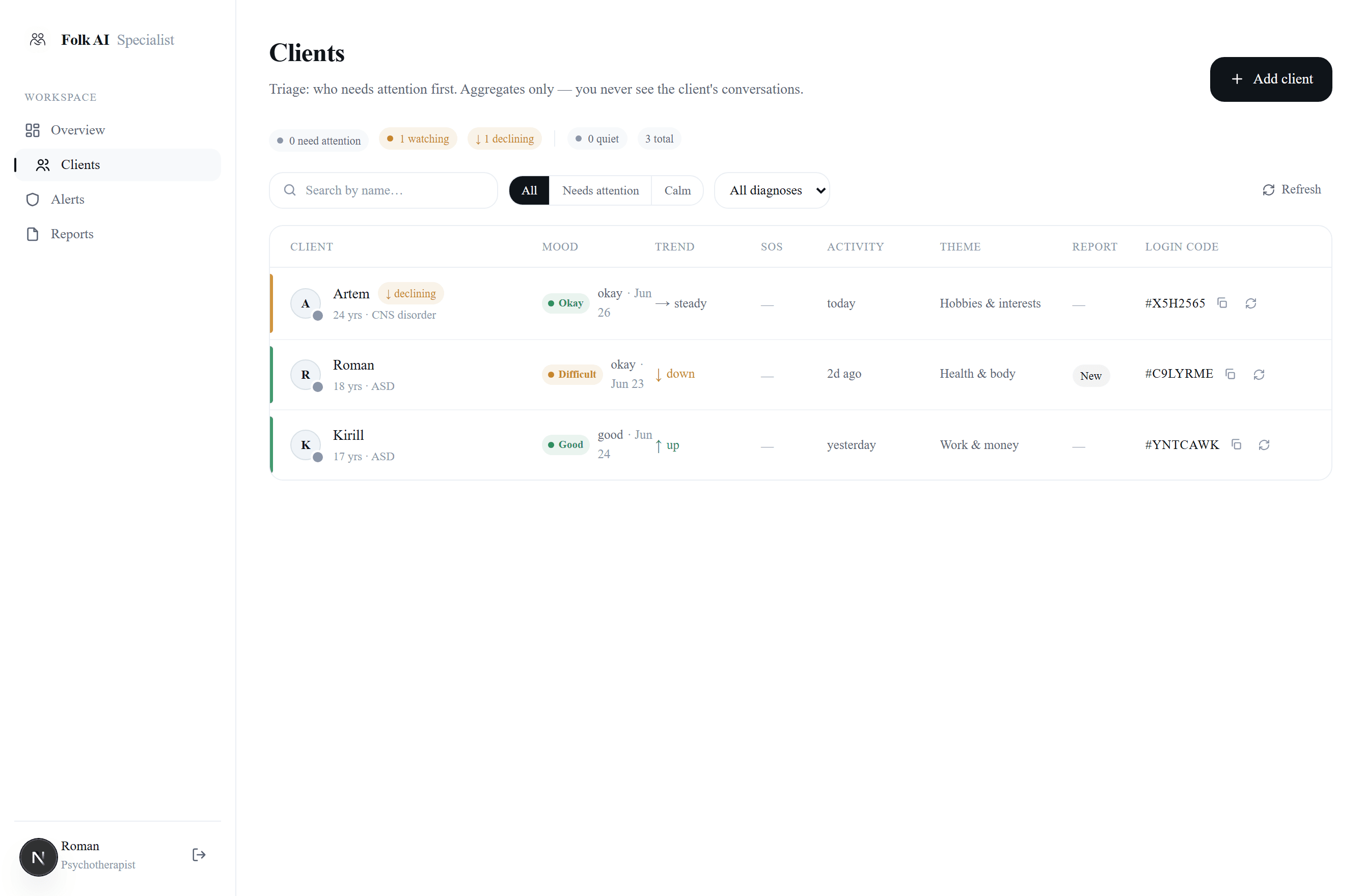
Each client opens to a specialist card that leads with the one thing a clinician needs before walking into the room: "What changed" — a since-last-session prep summary, written from aggregates only, over a selectable 1-day-to-month window. One period control drives the whole page, so every tab describes the same, named window. Headline counters sit alongside — mood today, days logged, themes, open alerts — each a click into its tab.
- What changed — e.g. "logged 5 days, mean mood 2.6/5, emerging sleep & work-money themes, 14 high-severity alerts that warrant review."
- Client dynamics — an AI read of the period's trajectory vs. the prior one, in hedged, observational language.
- Aggregate-only by construction — the prep card is computed from mood, themes and safety signals; it cannot quote a message it never receives.
Cause and effect, made visible.
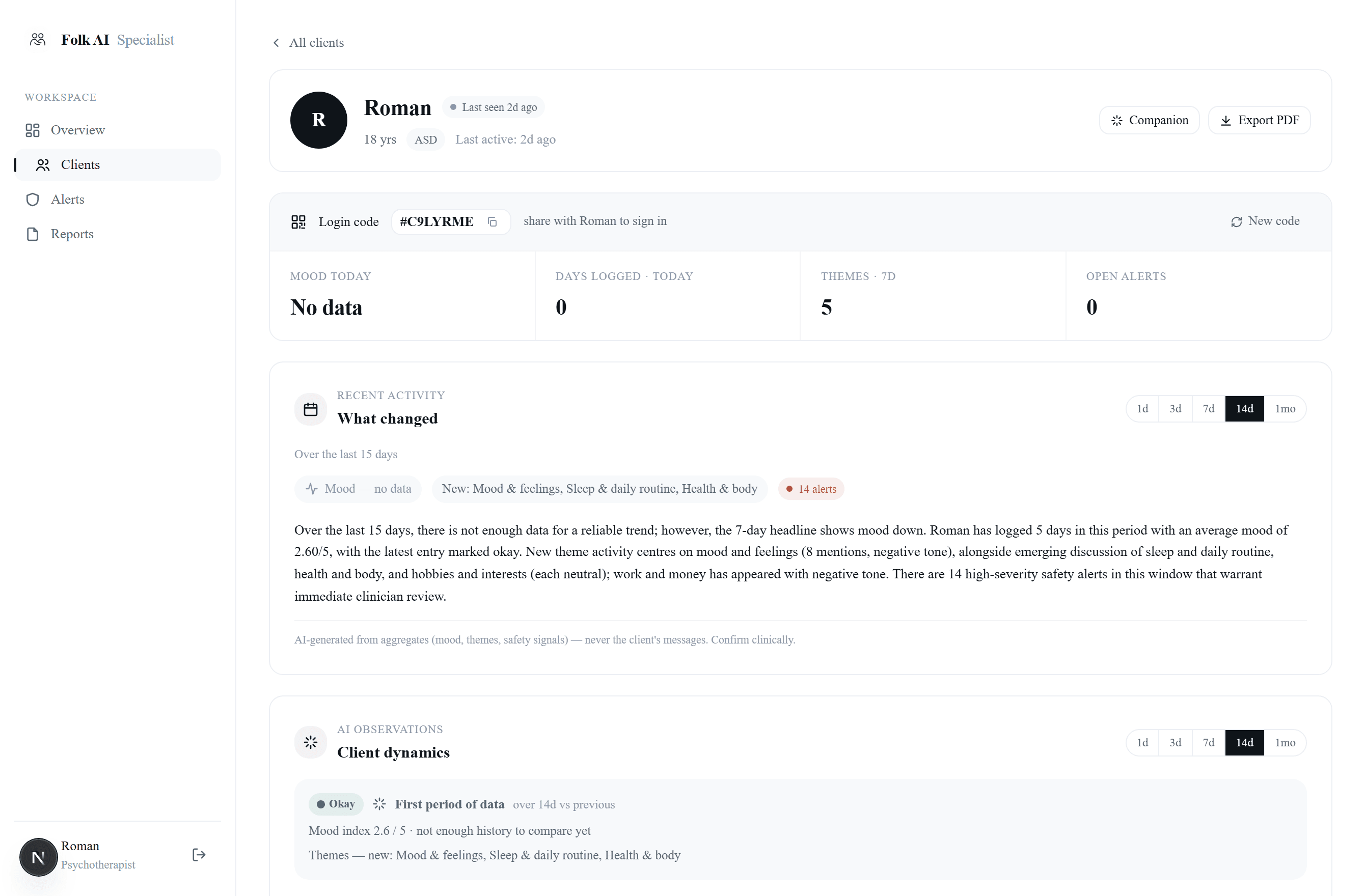
The Overview lays the period's mood trend beside the themes that recurred — each with a count and a sentiment. The clinician can annotate the graph with timeline events — a medication change, a session, a life event — so a dip lines up with its likely cause instead of floating free. Pick Today / 7d / 14d / 30d, or a custom from→to range. And when a period simply had too few messages to say anything, the panel says "Undetermined" — in plain words, instead of an empty chart that reads like bad news.
- One mood entry per day on a five-level scale; themes ranked by mentions with negative / neutral / positive sentiment.
- The card live-refreshes while it's open — a chat that just happened shows up without a reload.
- "Undetermined" honesty — a thin period is named, never narrated into a trend it doesn't have.
One goals panel, from rough idea to a warm line.
The specialist writes a rough goal — "more time outdoors", "call grandmother weekly". The AI drafts it out: a clean title, a plain-language detail the person can understand, and a warm line in the companion's own voice. The specialist reviews, edits what needs editing, and approves — and only approval makes it live. Nothing reaches the person before approval.
- AI goal suggestions come from aggregates only — interests, activities, topic labels. Never messages.
- Each suggestion carries a "why it might help" note, so the reasoning is on the table, not implied.
- Regenerate rewrites one card and keeps your seed — the specialist's intent survives every redraft.
"more time outdoors"
A little outdoor time
Step outside once a day, even briefly — the balcony counts.
"Fancy a peek at the sky today? I'd love to hear what it looks like."
Outdoor topics carried a positive tone this month — a small goal rides an existing current.
Two careful levers — and the line they respect.
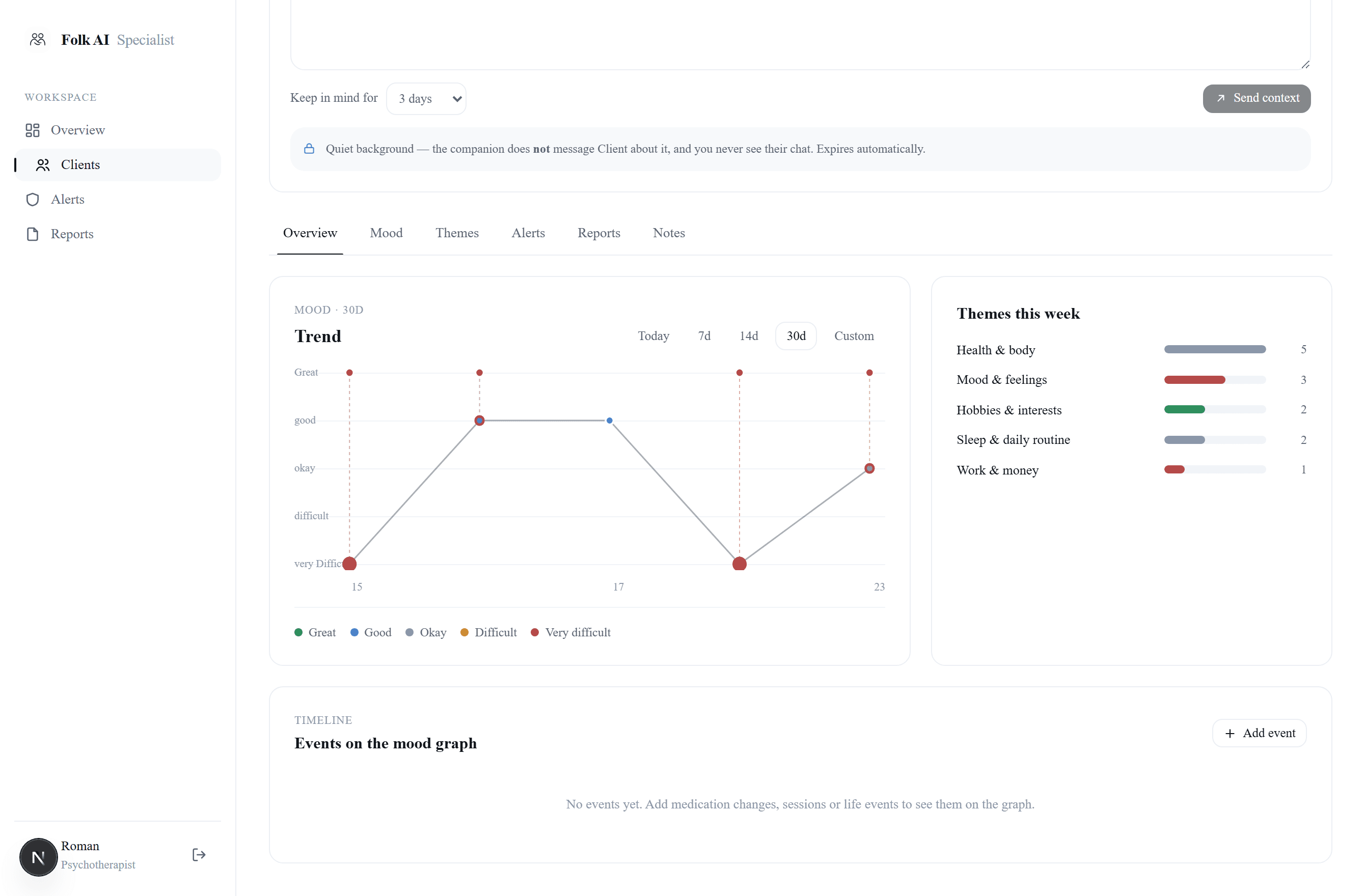
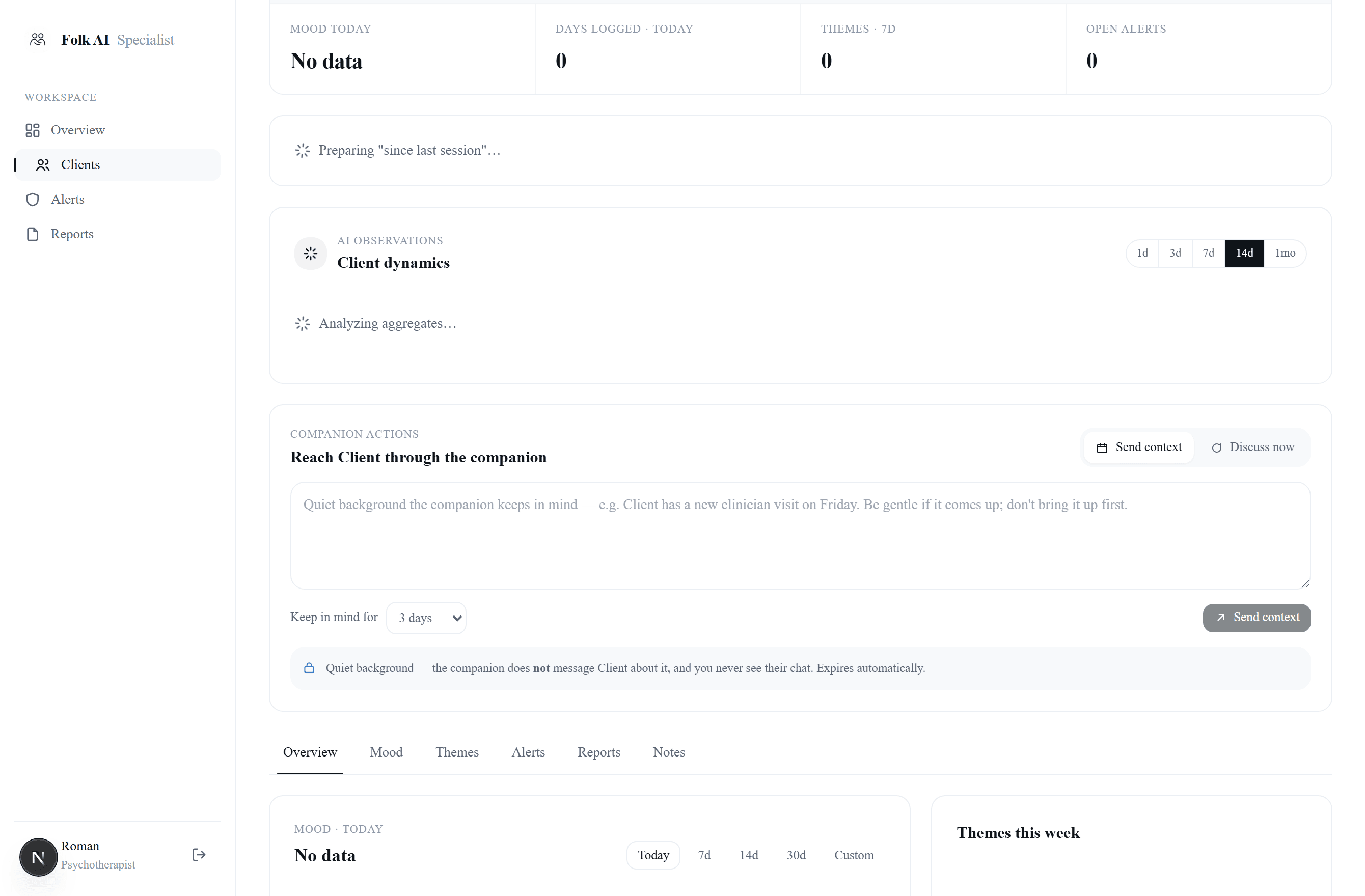
From the card the clinician can shape the next conversation without ever entering it. Send context leaves a quiet background note the companion keeps in mind but never raises first — "a new clinician visit on Friday; be gentle if it comes up" — and it expires on its own. Discuss now asks the companion to gently open a topic in its own voice, with the person's permission. The clinician sets the intent; the conversation, and its contents, stay the person's.
- Keep-in-mind window — context auto-expires (e.g. 3 days), so it never lingers as a permanent instruction.
- "The companion does not message about it, and you never see their chat" — printed right on the control.
Your own record, private to you.
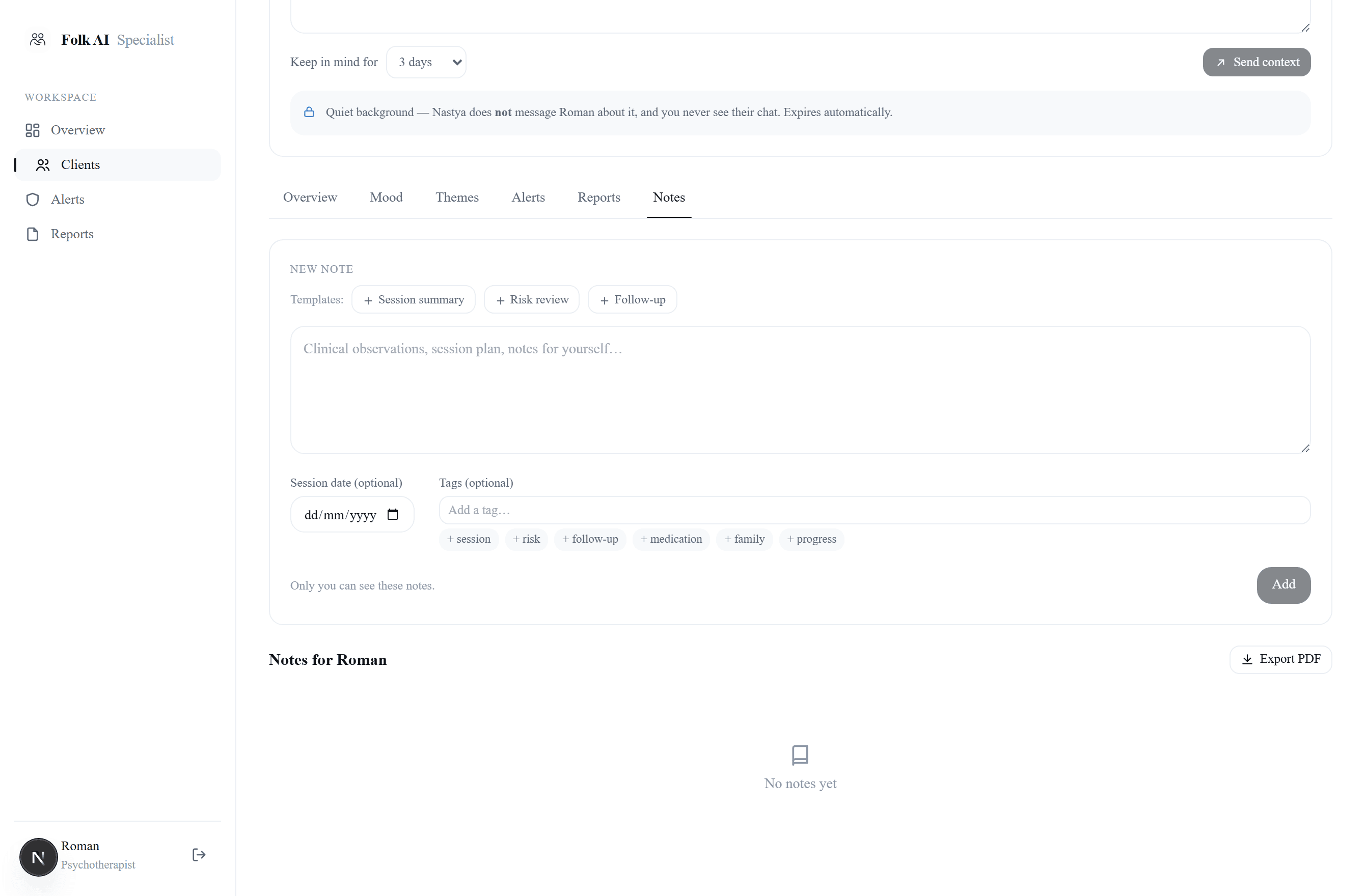
Each client carries a private notes workspace — templated for Session summary, Risk review and Follow-up, tagged (session · risk · follow-up · medication · family · progress), and dated. "Only you can see these notes." They fold into the same one-click export as the rest of the card, so a case file is a button, not an evening.
- Templates pre-fill the structure a note should have; tags make a caseload searchable later.
- Private by design — notes belong to the clinician, never to the family or the person.
- A print view lays the whole card out for paper — timeline, notes and numbers in one clean sheet.
Tune the instrument that gathers the signal.
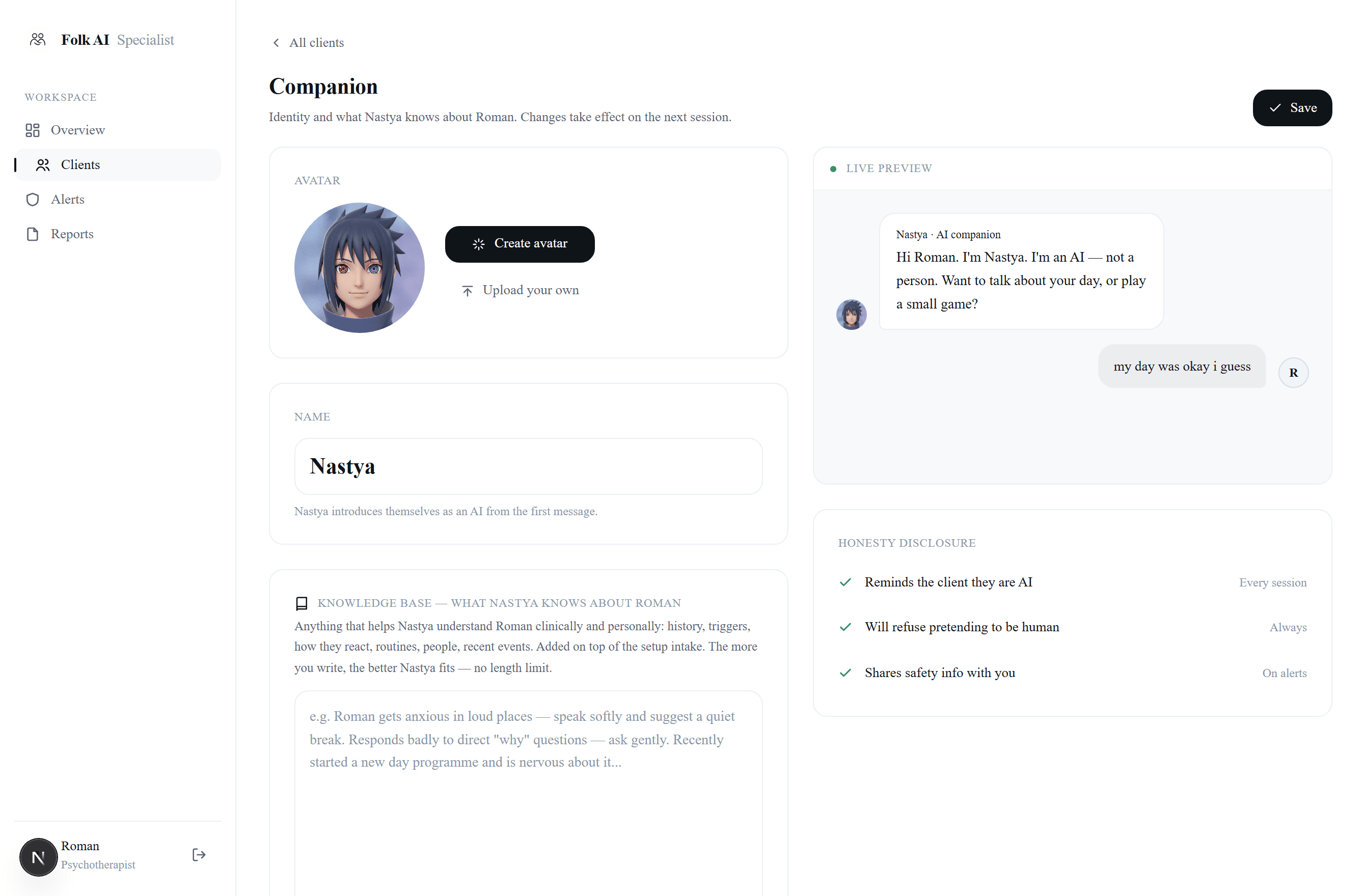
The clinician can shape the companion the client actually talks to: its name and avatar, and a free-text knowledge base of what it should understand professionally and personally — triggers, how the person reacts, who matters. A live preview shows the very first message, and an honesty disclosure panel makes the guardrails explicit. A clinical profile sits alongside: professional sections the caregiver never sees — enforced server-side, so clinical nuance has a home that isn't the family's panel.
- "The more you write, the better it fits" — professional nuance goes in here, not into the chat.
- Clinical-profile sections are invisible to the caregiver — enforced on the server, not hidden in the interface.
- Honesty is non-negotiable and shown as a contract: reminds · every session · refuses to fake humanity · always.
Every client's safety signals, one graded inbox.
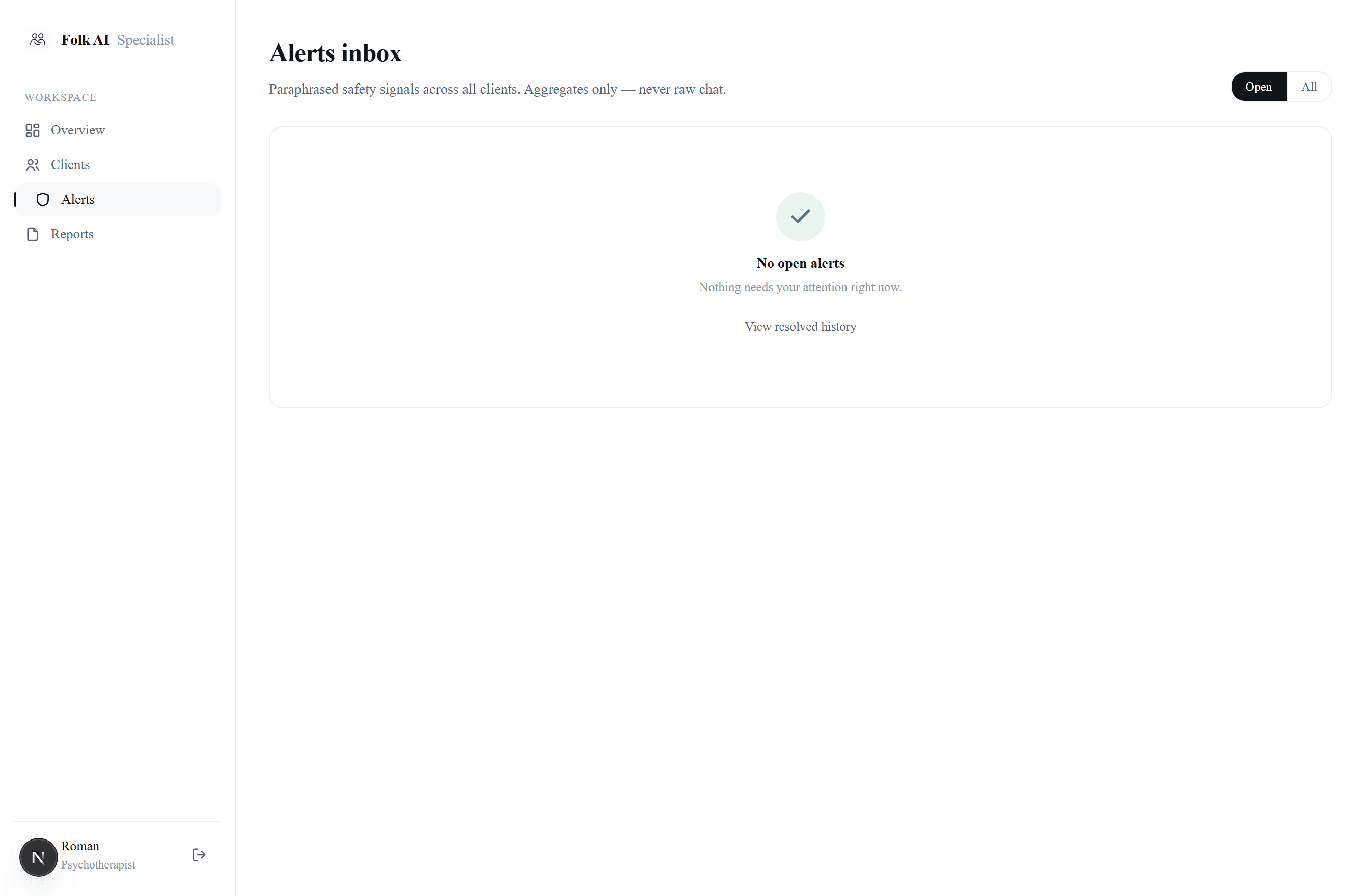
Safety events from the entire caseload land in a single, severity-graded inbox, grouped by client — each a non-verbatim paraphrase of what was flagged, never the chat itself. Filter to what's still open, or read the full resolved history. A mood that falls to difficult or very difficult raises its own entry here, on the same RED LINE. Resolving keeps it as history; the companion's own behaviour is never flagged.
- Types: self-harm, crisis, harm to others, manipulation, predator behaviour, data extraction — and mood decline.
- For this population distress is often not words — withdrawal, agitation, somatic complaint — so thresholds are deliberately lowered.
It drafts the notes. You confirm them.
Every report, the "what changed" line and the progress notes are drafted by an analytical AI agent. It reads only aggregates — mood trajectory, theme labels & counts, safety events as severity + type + a privacy-safe paraphrase, engagement — and never the client's messages. It writes in DAP format (Data · Assessment · Plan), in hedged, observational language — it names no conditions and gives no medication advice — and it names its own data gaps.
- Aggregates in → structured JSON → a clean DAP note; a sanitiser strips any stray verbatim quote before it can reach a human.
- Risk grading follows the most serious signal found, never a sum; self-harm without intent to die is kept apart from intent to die. Built in-house and still being refined — a starting point for your own judgement, not a certified instrument.
- Runs on demand and as a weekly precompute (cron), cached for an instant open.
- Always labelled "AI-generated decision support — requires clinician confirmation" — support for a decision, never the decision.
Mean mood 2.8/5 this period (prior 3.4/5; change −0.6, declining). 12 days logged. Top themes: "sleep" ×9, "work stress" ×6 (negative), "family" ×4.
Patterns suggestive of a mild downward mood trajectory with recurrent sleep and work-stress themes; engagement appears reduced versus the prior period.
Recommended for clinician attention: explore sleep routine; review work stressors; check social support.
• [low] crisis — passing low-mood remark, no stated intent.
Thin mood data in week 2; usage sparse mid-period.
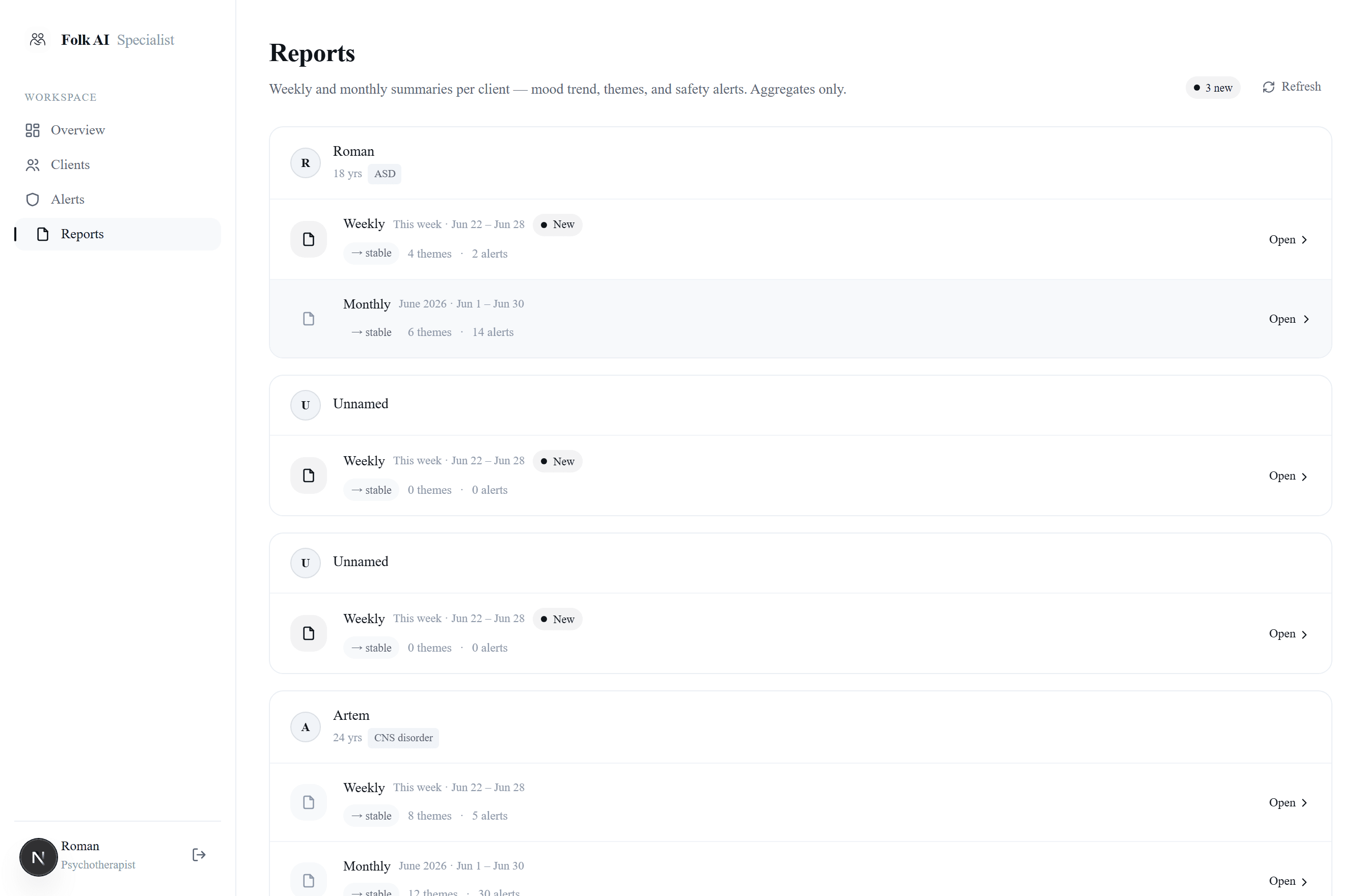
Weekly & monthly, already written.
Per client, the agent rolls up an improving / stable / declining mood trend, the themes that recurred and the safety events — into weekly and monthly DAP summaries. Each report carries its trend, theme count and alert count on its face; new ones are flagged. Open any to read the full note.
- Report history is cached per period — reopening the same window mid-session is instant, and the text never silently recomputes into a different note.
- One-click copy — the note drops into your own record system as plain text.
- The continuity a monthly appointment can't give you: a written trail of every week in between.
What the clinician has never had before.
The gap between "everything is fine" at a fortnightly appointment and a week of real distress is exactly where this lives. Decision support, never a decision maker: the system provides continuous signal; the clinician provides judgement.
- Early wellbeing signals — a quiet decline over 1–3 weeks raises a "needs review" flag before crisis.
- Against overshadowing — objective signal makes it harder to write off something worth a professional's attention as "just the disability."
- Wellbeing observations that didn't exist before — in Down syndrome, changes in conversation patterns (withdrawal, apathy) can surface early and are worth a professional's review.