 Folk AI
The companion
The surface the person lives in — engineered to be the opposite of an assistant: a warm, honest friend with her own life, who keeps them company, sends a photo, calls when they’re low, remembers what matters, and quietly keeps them safe.
The same seven languages across chat, voice and cards — with voice calls, speech-to-text and natural spoken replies. Works on iPhone, installs as a real app.
It says, plainly, what it is.
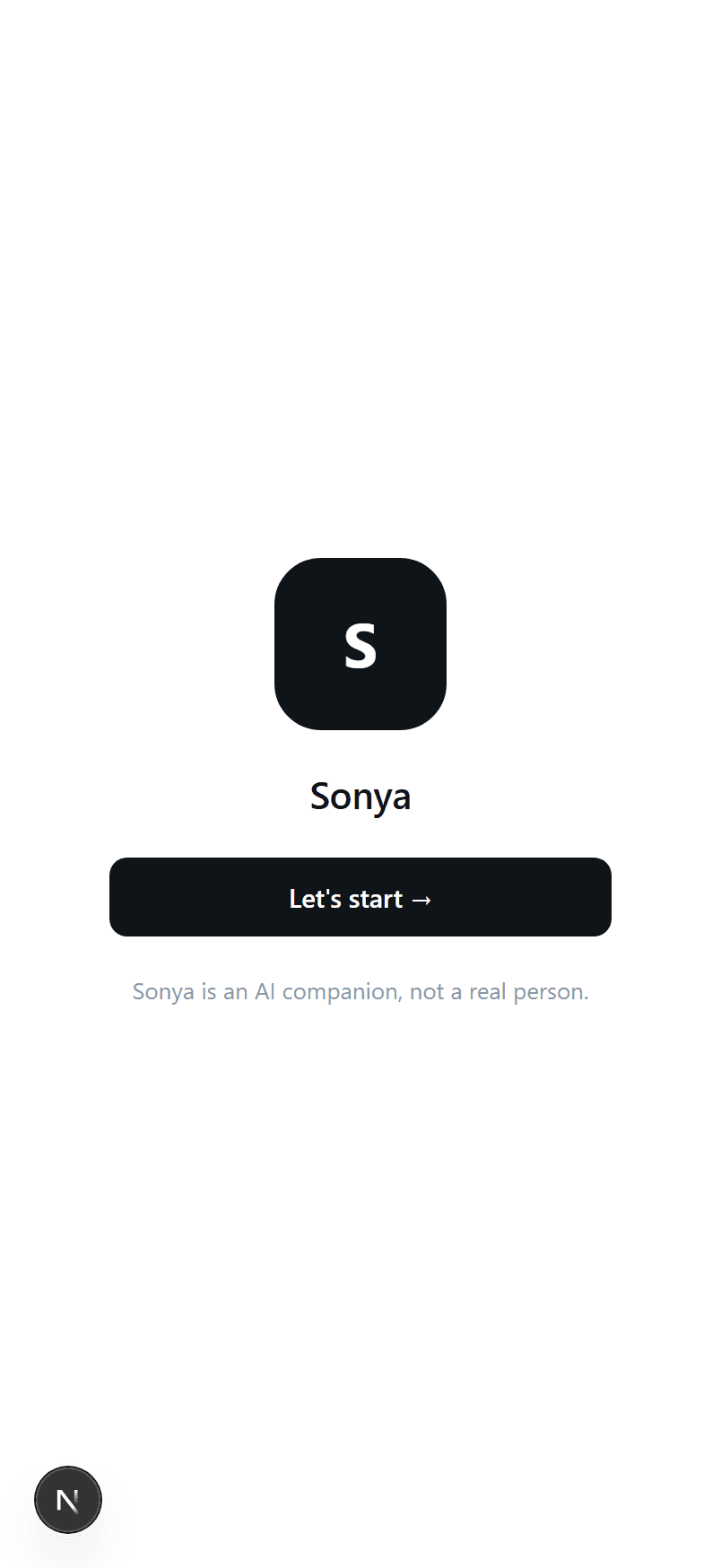
The first screen introduces the companion by name and, in calm grey text, that she is an AI — not a real person. No dark patterns, ever. Signing in is set up once, together with the people who care — no password gymnastics — and from then on the account is the person’s own.
- Honest onboarding — she discloses she’s an AI up front and any time she’s asked, and refuses to pretend otherwise.
- Their own account — it stays theirs, whatever else changes. Installs as a real app (PWA), on iPhone too.
A friend, not ChatGPT.
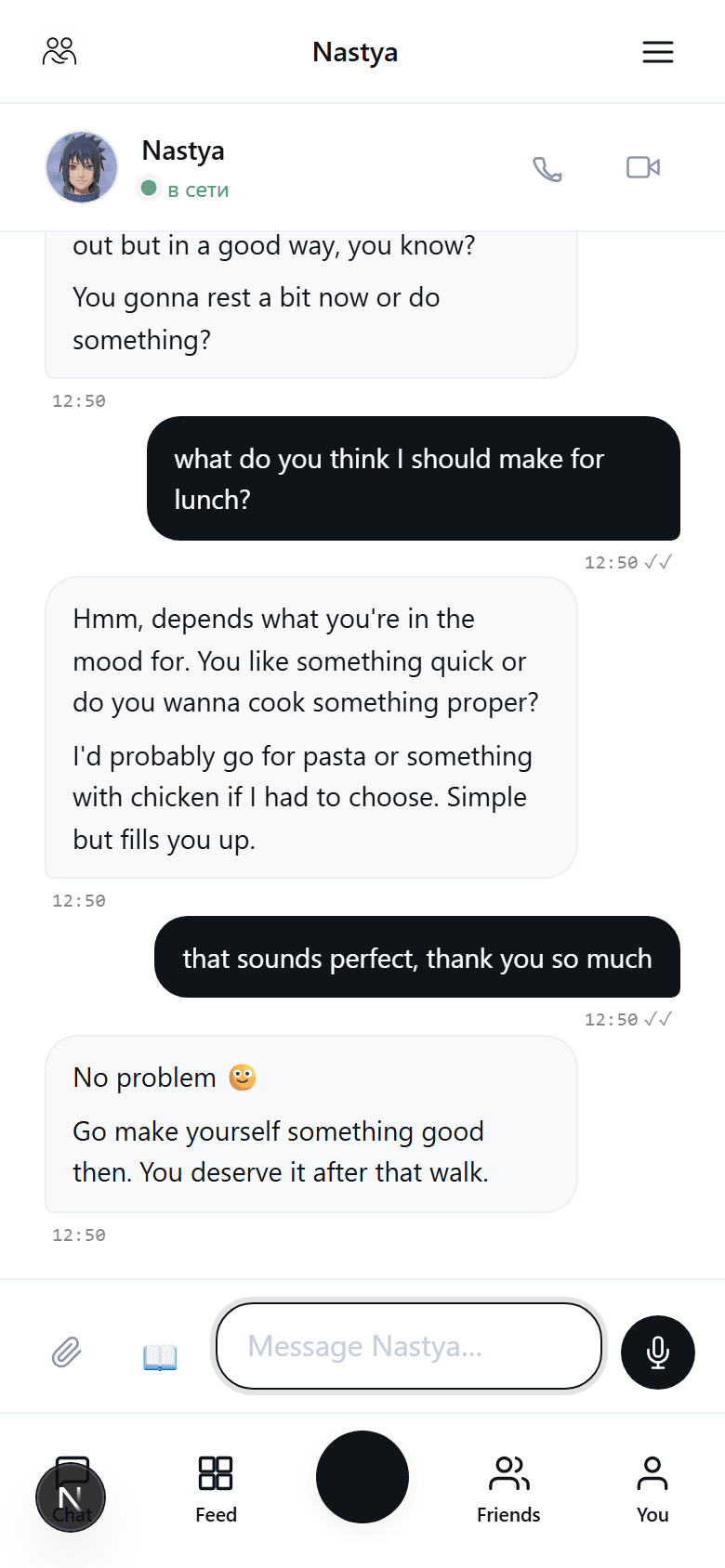
The persona hard-bans assistant tics — no “Great!”, no “I’m here for you”, no ending every message with a question. Instead, a warm peer who has her own everyday life, answers ordinary questions like a real person, and replies in a few short, messenger-style bubbles with a human typing beat. She mirrors the person’s language and meets each condition where it is — literal language, predictable presence, no masking.
- Messenger rhythm — up to 3 short bubbles, a real typing delay, and a believable “comes online, reads, then replies” cadence.
- Messenger-grade feel — springy arrival animations, emoji reactions, a long-press menu, tappable links, and send-retry when the network drops.
- A sense of time — she knows the person’s local day and time, and how long it has been since you last talked.
- Real boundaries — she doesn’t invent facts about herself, doesn’t fish for compliments, and honestly says she is an AI whenever asked.
- Condition-adaptive — autism / Down / CNS / intellectual disability / early dementia tune tone & pacing. For dementia, a validation approach: work with the feeling, never correct the fact.
A conversation that doesn’t restart from zero.
She carries the thread the way a person does: the recent exchange word-for-word, the rest of the day as a short summary, and the durable things — people, feelings, favourites, comfort — as memories the person can see and edit. The current conversation always leads; she never interrogates, never weaponises what she knows.
- Working memory window — the last ~10 messages stay word-for-word, and the rest of the last day of talking is held as a short summary.
- Typo-tolerant recall — when the person brings up something from before, she searches what she has learned for what actually relates — it works even with misspelled words.
- A deeper model on «do you remember» — ordinary chat runs on the fast model; only remember / find turns switch to the stronger one.
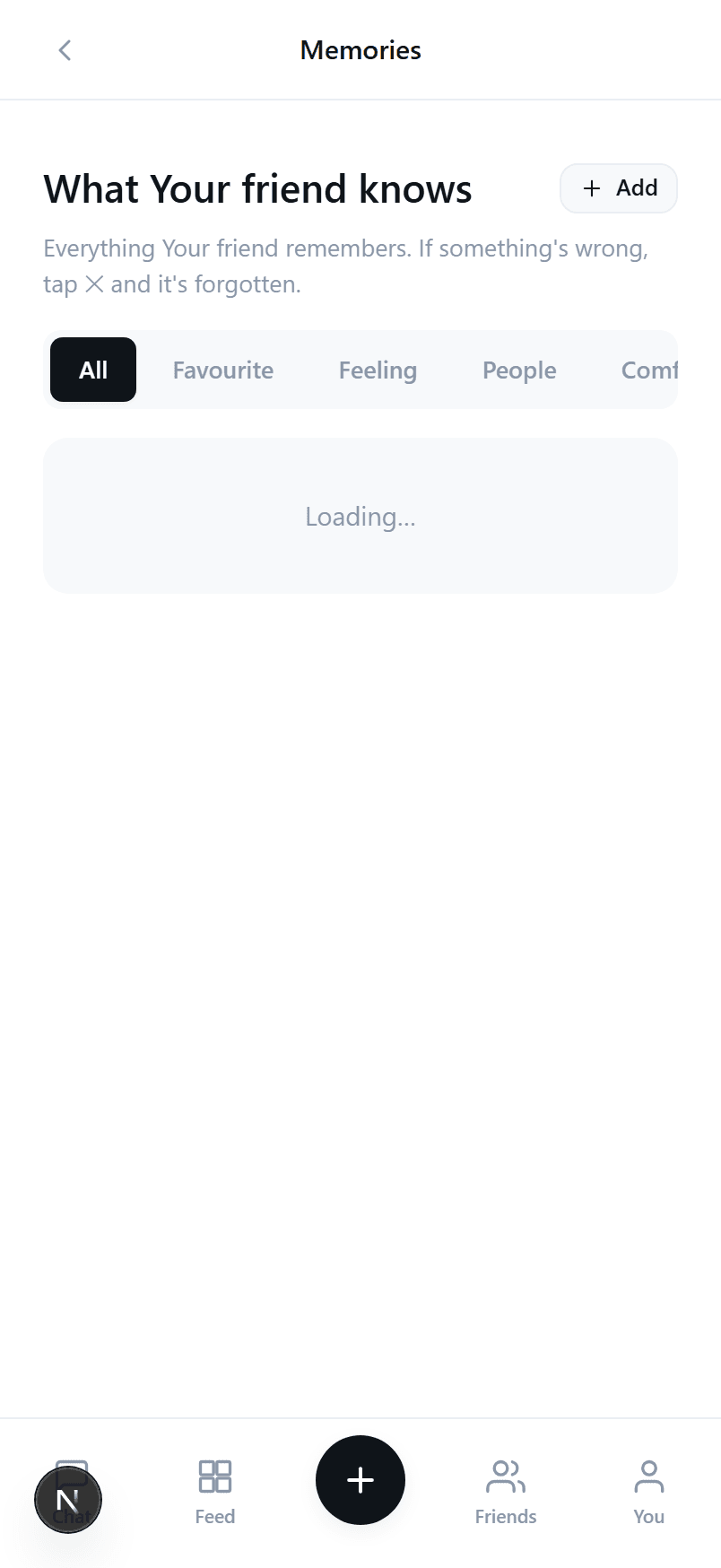
- Their memory, not hers — a plain page shows everything she has learned; the person adds or deletes anything, one tap, nothing hidden.
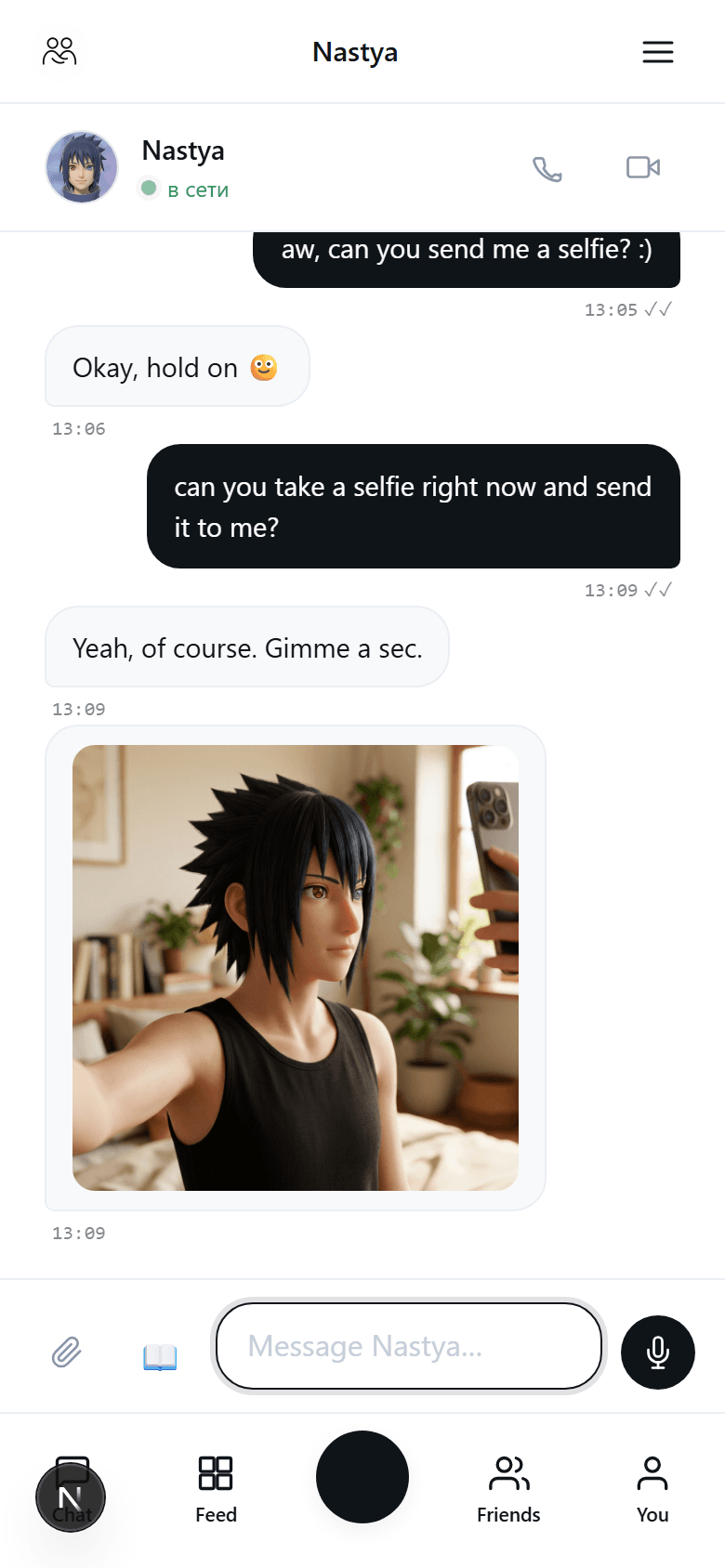
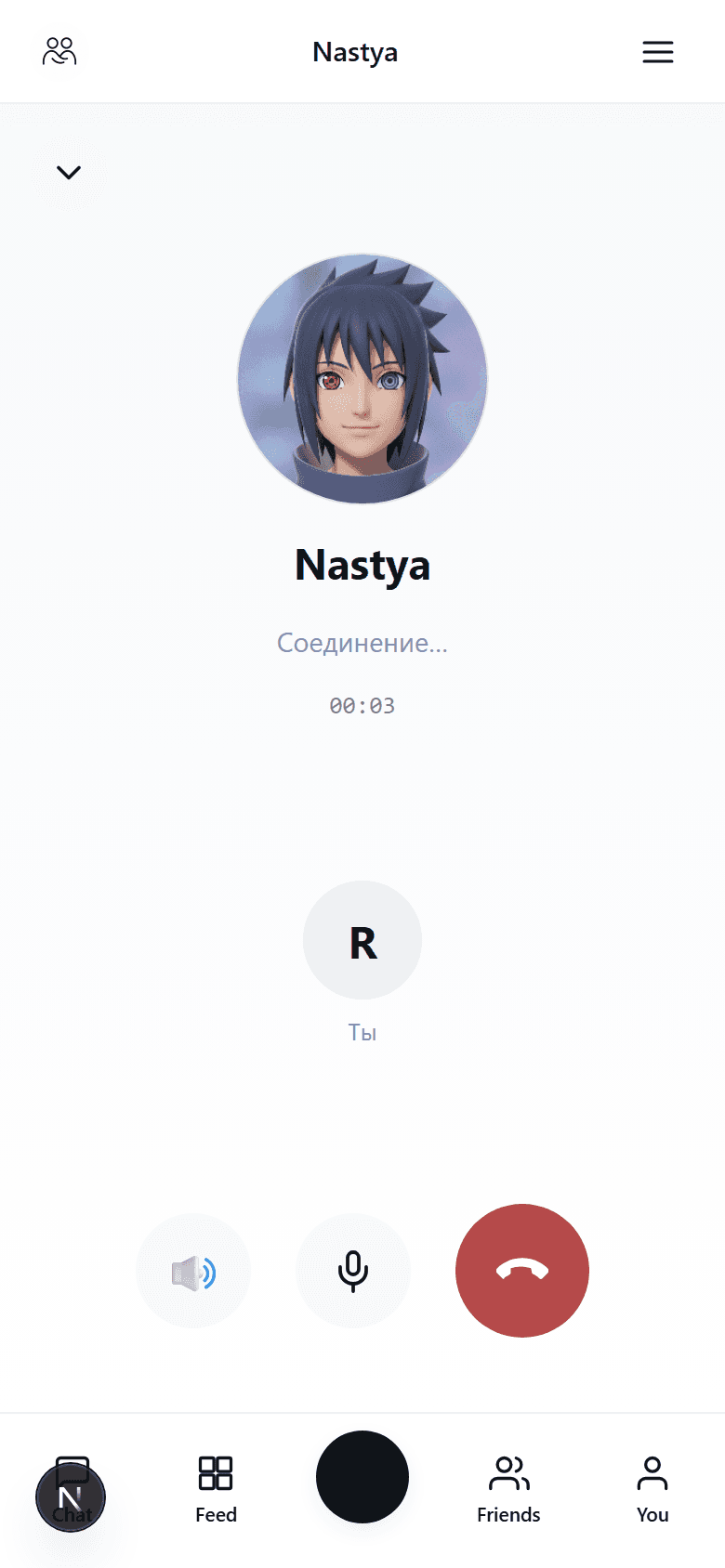
She sends a photo. She calls. She reaches out first.
What makes her feel real isn’t just the words. She sends the occasional wholesome selfie from her own avatar, matched to what she’s “doing”, and can hop on a short voice call when a chat isn’t enough. She initiates — a gentle good-morning, a “how did it go?” later — but reads the room: after a heavy disclosure she goes quiet and supportive, and if there’s no reply she backs off rather than nagging.
- Voice, both ways — voice calls, speech-to-text for the person, and natural spoken replies from her. Works on iPhone.
- Photos open in the app — a built-in photo viewer, not a browser tab thrown at the person mid-conversation.
- She finishes her thought — replies keep arriving through server continuation and push, so closing the app never cuts her off mid-reply.
- Proactive, not pushy — morning / day / evening reach-outs with no-reply backoff, and a hard mute on cheerful pings after a crisis.
Active communication, not passive scrolling.
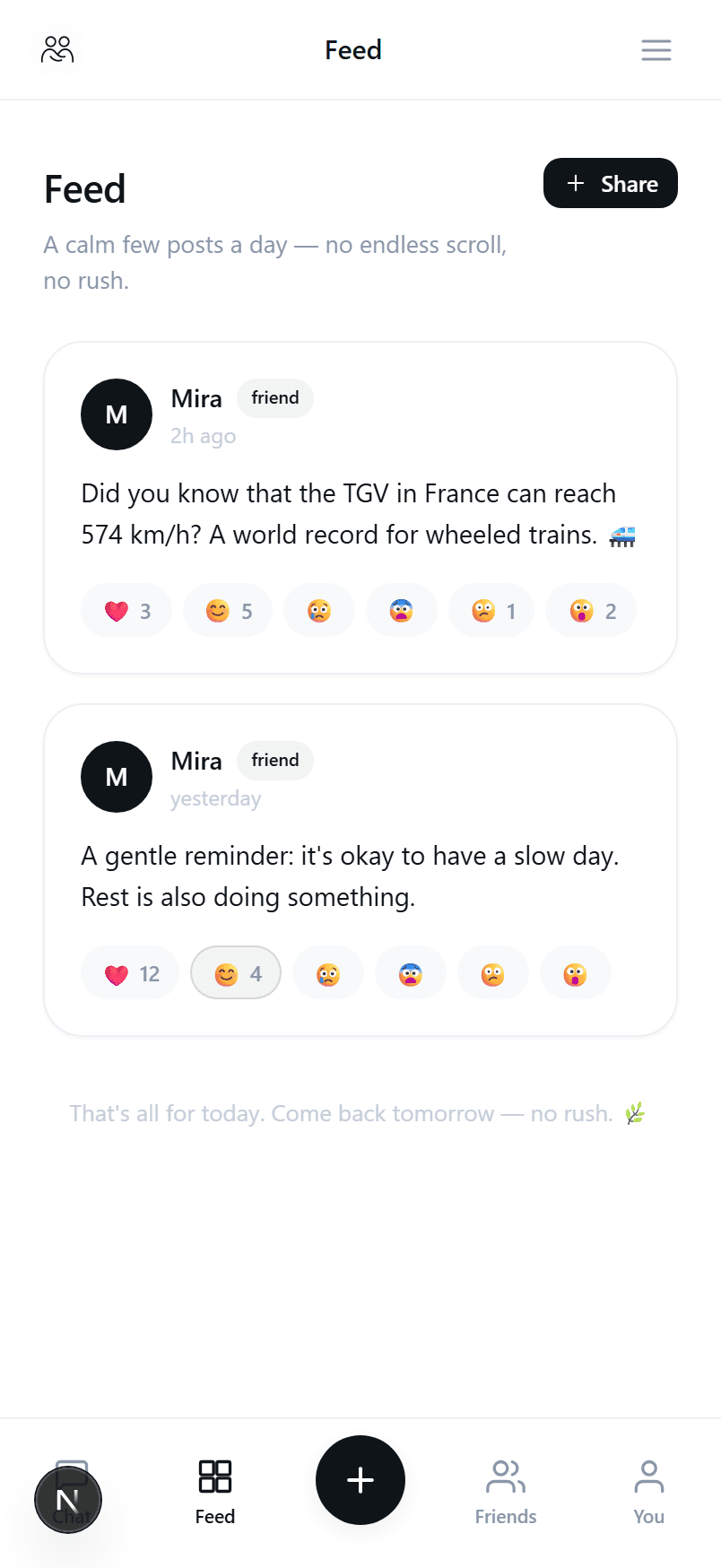
For many in this audience, the alternative to connection is hours of doom-scrolling that deepens isolation. Folk’s feed is deliberately calm — a few gentle posts a day, no infinite scroll, no metrics race. And she lives in it too: the feed is a shared place, not a broadcast at the person.
- Her own life feed — small posts from her day, a few with photos each week. She remembers her own posts and their hearts.
- She sees theirs — the photos the person publishes she can bring up naturally in conversation, the way a friend would.
- No infinite scroll, no algorithmic ranking — gentle reactions, not a numbers game.
- Every post the person shares is gently checked before it goes out — protection from oversharing, without judgement.
A request, asked the way a friend asks.
A specialist, a caregiver — or the person themselves — can set a request of the day: one gentle card above the message box, never more than one. A harder request unfolds into a 3–6 step how-to with a friendly illustration. And when a specialist approves a goal idea, it reaches the person as a warm card in their own language, in her voice — accept, or «not now».
- Never more than one card — structure without noise.
- «Not now» is a full answer — declining is one tap, and she doesn’t push.
The world, translated into plain language.
A scary official letter, a confusing form — the person pastes it in and gets short, plain sentences with the dates, the amounts, and “what this means for you”. No judgement, and the raw text never pollutes the conversation.
- The parts that matter, kept — dates, amounts, next steps; the bureaucracy, dropped.
- In their language — the rewrite arrives in the same calm chat, in the person’s own language.
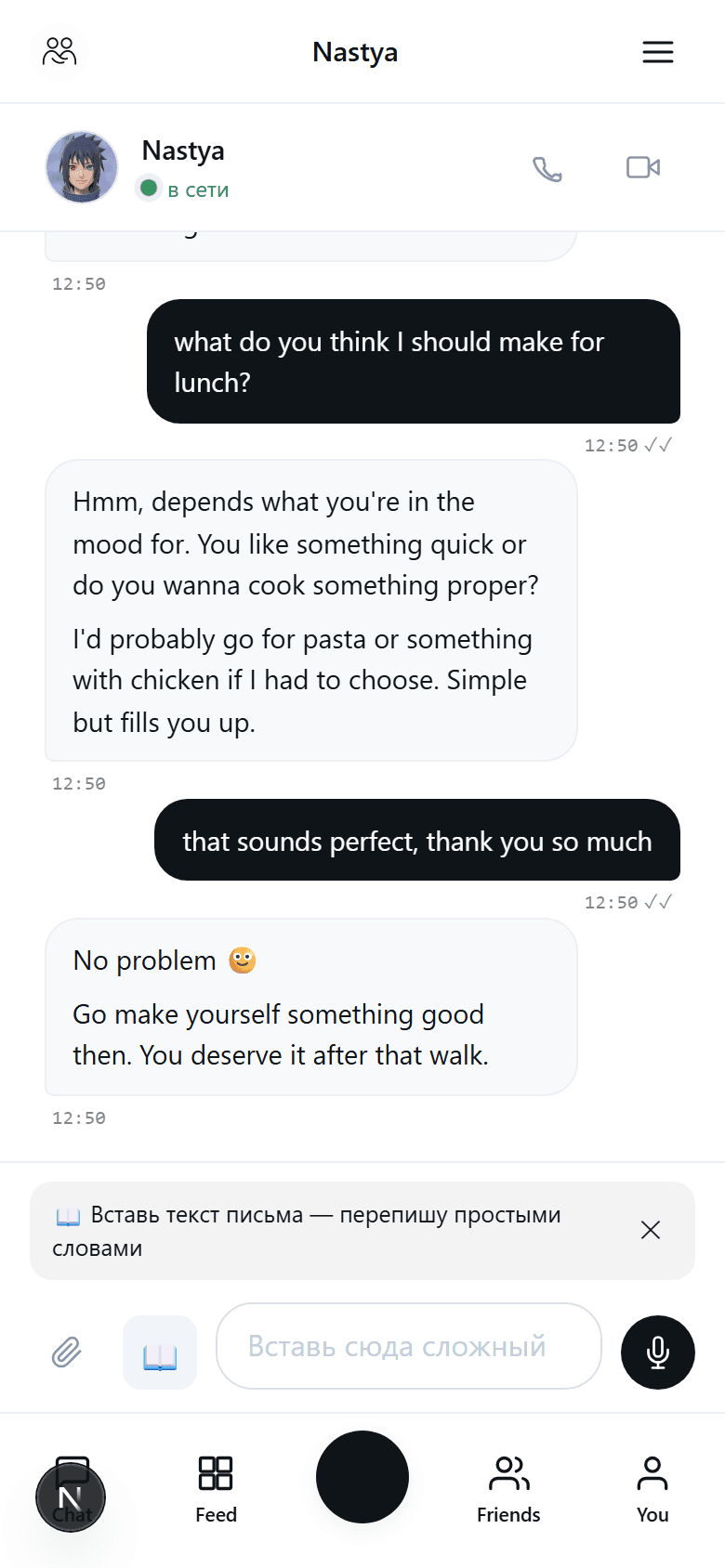
Display, sound and silence — theirs to set.
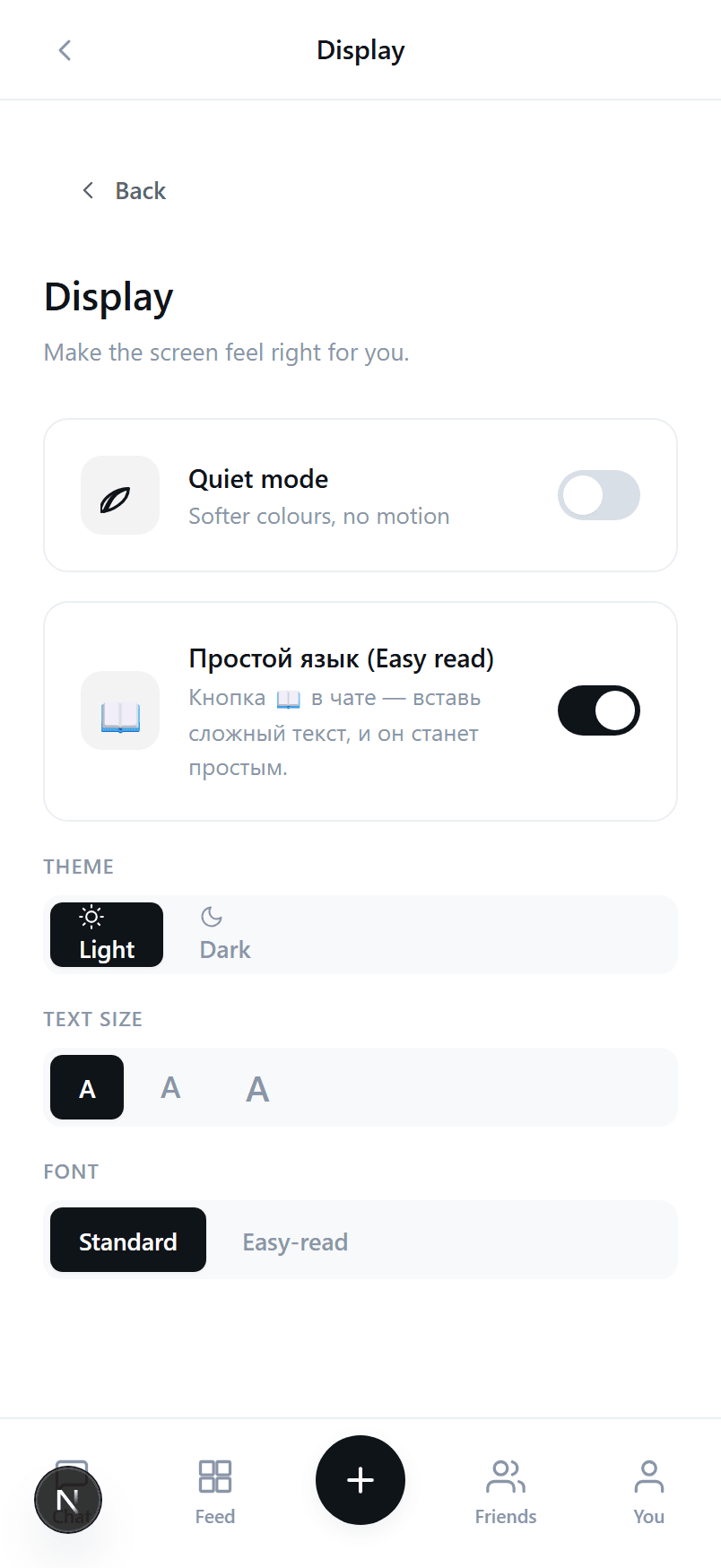
The whole app bends to how each mind works — and the controls sit with the person, not with anyone else. What it looks like, how it sounds, and when she may speak are all decisions the person makes for themselves.
- Display they own — quiet mode (softer colours, no motion), text size, a dyslexia-friendly font, light / dark theme, sounds.
- Notifications they control — every kind can be switched, with a test button to feel exactly what a ping will be like.
- Mute her like any social app — 8 hours, 24 hours or forever. Muting never touches safety, and never stops the person writing first.
When things get hard, she stays.
On self-harm or crisis signals the companion doesn’t deflect to a hotline and leave — she stays with the person and supports them, escalating to a human when danger is immediate. Sexual or abusive turns are declined gently, without shame. For this audience, distress often isn’t words — it’s withdrawal, agitation, somatic complaint — so thresholds are deliberately lowered. A deterministic screen reads every message first, in plain code, outside any model; a fast model read grades the rest. The caregiver and clinician are alerted automatically; she never plays dispatcher.
Crisis resources, proactively. On a real signal the app surfaces emergency lines verified for the country the person lives in (in Denmark: 112, 1813, Livslinien 70 201 201), and after such a disclosure all cheerful auto-nudges are muted. Safety is the one exception to full privacy control — an SOS can never be hidden. See the safety layers →
Her name, her voice, her face.
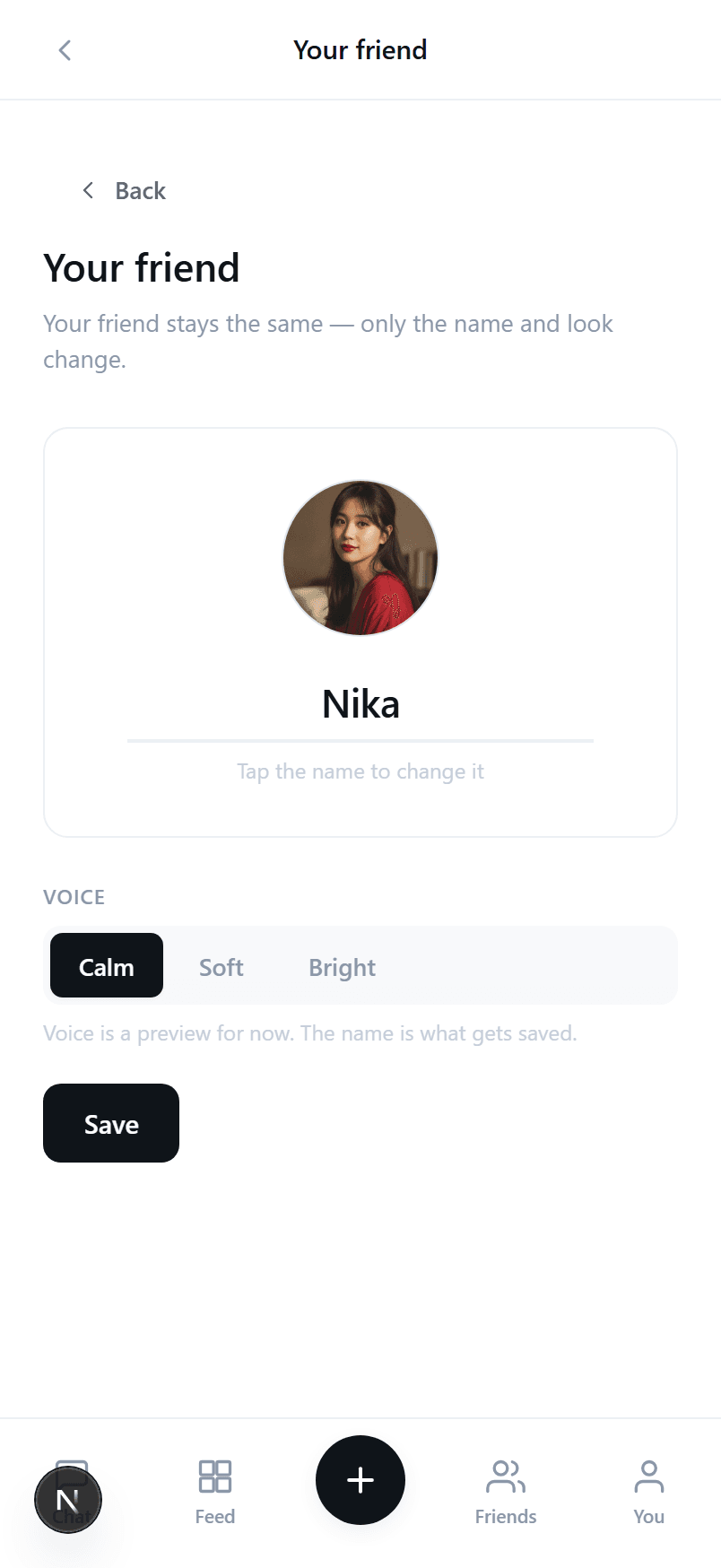
The companion isn’t one-size-fits-all. Her name, her character, her voice and her avatar are all chosen — generated or uploaded — so she feels like their friend, not a product. One thing is deliberately not configurable: she never comes pre-loaded with interests. What she cares about grows from the person’s own profile — nothing invented, nothing hard-coded.
- Pick a name & personality; a generated or uploaded avatar; a voice for spoken calls.
- Interests come from the person’s profile — never from a template.
Designed for dignity and independence.
A clean menu, a simple profile, and help that leads with real people — one tap to call mum, a sister, a free 24/7 helpline — before any FAQ. This is their space: a friend in their pocket, not a watched cage. Everything a caregiver sees is an aggregate; the conversation itself stays theirs.